
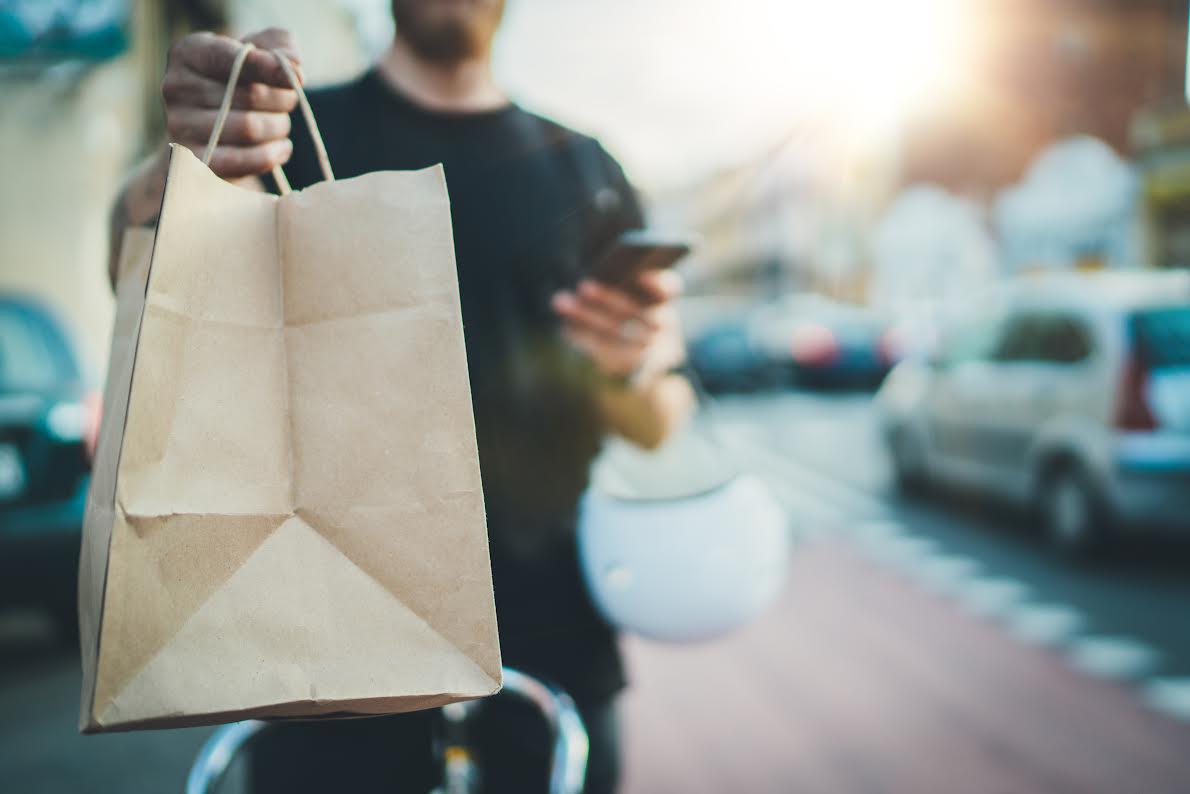
Young Americans across the United States are increasingly embracing the convenience economy. A recent article in the New York Times detailed shifting attitudes toward food delivery, specifically, the tradeoff many Americans now accept: paying a premium for delivery in exchange for a reduced “mental load” from cooking and cleaning.[1] This shift reflects a broader reprioritization of time and effort in daily life. In fact, many working Americans would rather absorb the added cost than expend the time and effort required to prepare meals or to grocery shop.[2] That same preference for convenience is evident in how younger consumers choose to socialize, as they are more likely to order delivery to a gathering than dine inside a restaurant.[3] In fact, in 2024 alone, almost three out of every four restaurant orders in the United States weren’t eaten in a restaurant.[4]
These shifting consumer preferences reflect the rapid expansion of the gig economy following the COVID-19 pandemic. During the pandemic, demand for delivery services surged as many Americans were unwilling or unable to leave their homes.[5] Companies such as Uber (through Uber Eats), DoorDash, and Instacart grew dramatically to meet that demand.[6] These platforms allow individuals to sign up to complete deliveries, typically compensating workers on a per-delivery basis.[7] What began as a public health necessity evolved into a lasting consumer expectation: groceries, restaurant meals, medications, pet care, and even furniture assembly are now routinely outsourced through app-based platforms.[8]
In the post-pandemic economy, gig work is no longer sustained solely by consumer preference; it is increasingly reflected in legislative initiatives. Congress, for example, has considered proposals such as the Delivering for Rural Seniors Act of 2026, which would expand grocery delivery access for low-income seniors through federally supported pilot programs.[9] If enacted, such legislation would embed app-based delivery services into public infrastructure, effectively relying on gig platforms to carry out government-supported objectives.[10] The combined forces of consumer reliance and legislative integration intensifies the pressure on employment law to reassess the classification of gig-workers in an evolving workforce.
Traditionally, gig workers have been treated as “independent contractors” rather than “employees” under the National Labor Relations Board’s (“NLRB”) interpretation of the National Labor Relations Act (“NLRA”).[11] The distinction consequential because the NLRA provides statutory protections only for “employees” under the Act.[12] Independent contractors are expressly excluded from coverage and therefore fall outside NLRA’s collective bargaining framework, as well as many related state and federal employment protections.[LR1] [13] To distinguish between the two categories, the NLRB applies a common-law agency test focused primarily on the employer’s “right to control” the manner and means of the work.[14] In recent years, however, the rapid expansion of gig work has complicated this analysis, prompting legal debate over whether gig workers should properly be classified as employees or independent contractors. If gig workers were reclassified as employees, app-based platforms would face substantial legal and financial obligations under the NLRA and other employment statutes.[15] As a result, the classification question is not merely technical, but it sits at the core of the gig economy’s continued viability.
At first glance, gig work appears to align with independent contractor status. For example, a DoorDash driver can log onto the app at will, select which orders to accept, reject low-paying deliveries, and sometimes work for multiple platforms simultaneously.[16] Compensation is typically per delivery rather than hourly, and the driver typically has no guaranteed shift structure.[17] These characteristics may suggest that drivers exercise a certain degree of autonomy and entrepreneurial opportunity, but this analysis becomes more complicated upon closer inspection.
In 2023, DoorDash introduced an alternative payment model allowing drivers to opt for hourly pay.[18] Under this system, drivers must accept a higher percentage of incoming orders and may schedule work days in advance.[19] These features resemble traditional employment structures: set schedules, wage-based compensation, and diminished discretion in selecting assignments.[20] When workers must accept assignments or risk deactivation, the “right to control” factor begins to shift from traditional autonomy exercised by an independent contractor and toward the type of employer-imposed control characteristic of an employee under the NLRA. As gig platforms increase operational structure in response to demand, the legal characterization of the relationship becomes less clear.
State legislatures have attempted to address gig worker classification directly.[21] In 2020, California voters approved Proposition 22, which classified app-based delivery and rideshare drivers as independent contractors while granting certain limited benefits.[22] The statute sought to clarify that drivers would remain contractors unless companies controlled key aspects of their work, such as setting mandatory hours or restricting multi-app work, while still allowing drivers to sue under California discrimination law and guarantee other benefits.[23]
Proposition 22 represented a significant victory for companies like DoorDash. By codifying app-based drivers as independent contractors under California law, the measure shielded platforms from the full suite of obligations associated with employee status, including traditional benefits such as employer-sponsored health insurance, disability coverage, and retirement contributions.[24] Although Proposition 22 required companies to provide certain limited benefits, it preserved the core contractor model on which these platforms rely. However, DoorDash’s 2023 introduction of an alternative hourly payment model complicates that framework. The reduced discretion over assignments begins to resemble the type of control traditionally associated with employment relationships. While Proposition 22 provided the gig economy with statutory stability in California, evolving platform practices seems to blur the distinctions the measure sought to preserve.
While Proposition 22 [KA2] was a clear victory for companies like DoorDash, it highlights the growing friction between formal employee classification and the evolving structure of gig-work. By allowing platforms to categorically define drivers as independent contractors under California law, the statute preserves the independent contractor model even as the nature of the work begins to change. DoorDash’s alternative hourly payment model illustrates this shift. Although the company frames these options as expanding flexibility, they also introduce elements of control that complicate the independent contractor designation.[25] As platforms adopt employment-like structures while maintaining categorical independent contractor classifications, the durability of existing classification frameworks under the NLRA becomes increasingly uncertain. The pressure to reconcile this tension will shape the next phase of employment law development. It is therefore unsurprising that Proposition 22 faced immediate legal challenges following its passage.
In Castellanos v. State of California, the California Supreme Court upheld Proposition 22 but left unresolved questions about the legislature’s authority to modify workers’ compensation systems and related protections.[26] Despite some lingering questions, the ruling was critical for companies like Uber and DoorDash. Reclassification of drivers as employees would require compliance with minimum wage laws, overtime requirements, unemployment insurance contributions, workers’ compensation coverage, and collective bargaining rights under the NLRA. The financial implications could significantly alter the current business model, which depends on the lower labor costs associated with classifying drivers as independent contractors rather than employees.[27]
Essentially, the modern gig worker no longer fits neatly into traditional employment categories. Historically, independent contractors selected their assignments, set or influenced pricing, and bore entrepreneurial risk.[28] Although today’s gig-workers may still log on voluntarily, increasingly structured scheduling, algorithmic oversight, and alternative compensation models blur the distinction between independent contractor and employee. Categorically defining gig-workers as independent contractors through measures like Proposition 22 provides short-term clarity. It stabilizes how drivers are treated under the NLRA, limits uncertainty regarding benefits obligations, and reduces legal volatility for companies like DoorDash.
But that clarity comes at a cost. Rigid classification frameworks strain under the realities of the platform-based work, exposing structural gaps in the NLRA’s binary definition of “employee” and “independent contractor.” As the nature of work continues to evolve, employment law will be unable to remain static. If gig platforms continue to incorporate employment-like features while retaining independent contractor labels, the legal system will inevitably confront a central question: whether the independent contractor model accurately reflects the modern gig economy, or whether employment law is on the verge of a fundamental recalibration.
[1] Priya Krishna, Freedom With a Side of Guilt: How Food Delivery Is Reshaping Mealtime, N.Y. Times (Jan. 31, 2026), https://www.nytimes.com/2026/01/30/dining/food-delivery-apps-doordash-uber.html?smid=url-share.
[2] Id.
[3] Id.
[4] From Trend to Transformation: Off-Premises Dining Now Essential for Restaurant Consumers, Operators, Nat’l Rest. Ass’n (Apr. 16, 2025), https://restaurant.org/research-and-media/media/press-releases/from-trend-to-transformation-off-premises-dining-now-essential-for-restaurant-consumers,-operators.
[5] Felix Richter, DoorDash Builds on Pandemic Gains in 2021, Statista (Feb. 17, 2022), https://www.statista.com/chart/26865/doordash-gross-order-volume.
[6] Id.
[7] Lauren Schwahn & Taryn Phaneuf, How Does DoorDash Work? Making Money as a Dasher, NerdWallet (Apr. 15, 2025), https://www.nerdwallet.com/finance/learn/make-money-doordash.
[8] Lukasz Below, The Gig Economy: A Tale of Two Labor Markets, ADP Rsch. (Nov. 20, 2025), https://www.adpresearch.com/the-gig-economy-a-tale-of-two-labor-markets.
[9] Delivering for Rural Seniors Act of 2026, H.R. 1538, 199th Cong. (2026).
[10] Id.
[11] Pedro Barros, Gig Worker Classification: What Businesses Need to Know, Remote (June 24, 2025), https://remote.com/blog/contractor-management/gig-worker-classification.
[12] Daniel O’Rourke, Am I Covered by the NLRA?, Emergency Workplace Org. Comm. (Dec. 12, 2025), https://workerorganizing.org/am-i-covered-by-the-nlra-9620.
[13] Jon O. Shimabukuro, Cong. Rsch. Serv., R46765, Worker Classification: Employee Status Under the National Labor Relations Act, the Fair Labor Standards Act, and the ABC Test 1 (2021).
[14] The Atlanta Opera Inc. and Makeup-Artists and Hair Stylists Union, 372 N.L.R.B. No. 95 (June 13, 2023).
[15] Tyler Walicek, Uber, Lyft and DoorDash Workers May Gain Employee Benefits Under New Labor Rule, Truthout (Jan. 12, 2024), https://truthout.org/articles/uber-lyft-and-doordash-workers-may-gain-employee-benefits-under-new-labor-rule.
[16] Schwahn & Phaneuf, supra note 7.
[17] Id.
[18] Kellen Browning, DoorDash, Shifting Business Model, Will Offer Drivers Hourly Pay, N.Y. Times (June 28, 2023), https://www.nytimes.com/2023/06/28/business/doordash-hourly-wage-option.html?smid=url-share.
[19] Id.
[20] Id.
[21] California Proposition 22, App-Based Drivers as Contractors and Labor Policies Initiative, Ballotpedia (Nov. 3, 2020), https://ballotpedia.org/California_Proposition_22,_App-Based_Drivers_as_Contractors_and_Labor_Policies_Initiative_(2020).
[22] Id.
[23] Miriam A. Cherry, Proposition 22: A Vote on Gig Worker Status in California, Comp. Lab. L. & Pol’y J. 1, 4 (2021).
[24] Darrell M. West, On Proposition 22, a big California victory for the gig economy, Brookings (Nov. 4, 2020), https://www.brookings.edu/articles/on-proposition-22-a-big-california-victory-for-the-gig-economy.
[25] Thanks to California’s Prop 22, Dashers are Doing Better than Ever, DoorDash (May 17, 2024), https://about.doordash.com/en-us/news/dashers-doing-better-than-ever-under-prop-22.
[26] See Castellanos v. State of California, 16 Cal. 5th 588, 552 P.3d 406 (2024).
[27] Diccon Hyatt, New Worker Classification Rule Could Disrupt the US Gig Economy, Investopedia (Jan. 20, 2024), https://www.investopedia.com/new-worker-classification-rule-could-disrupt-the-us-gig-economy-8546526.
[28] See generally Katherine Lim et al., Independent Contractors in the U.S.: New Trends from 15 years of Administrative Tax Data 5 (2019), https://www.irs.gov/pub/irs-soi/19rpindcontractorinus.pdf.