
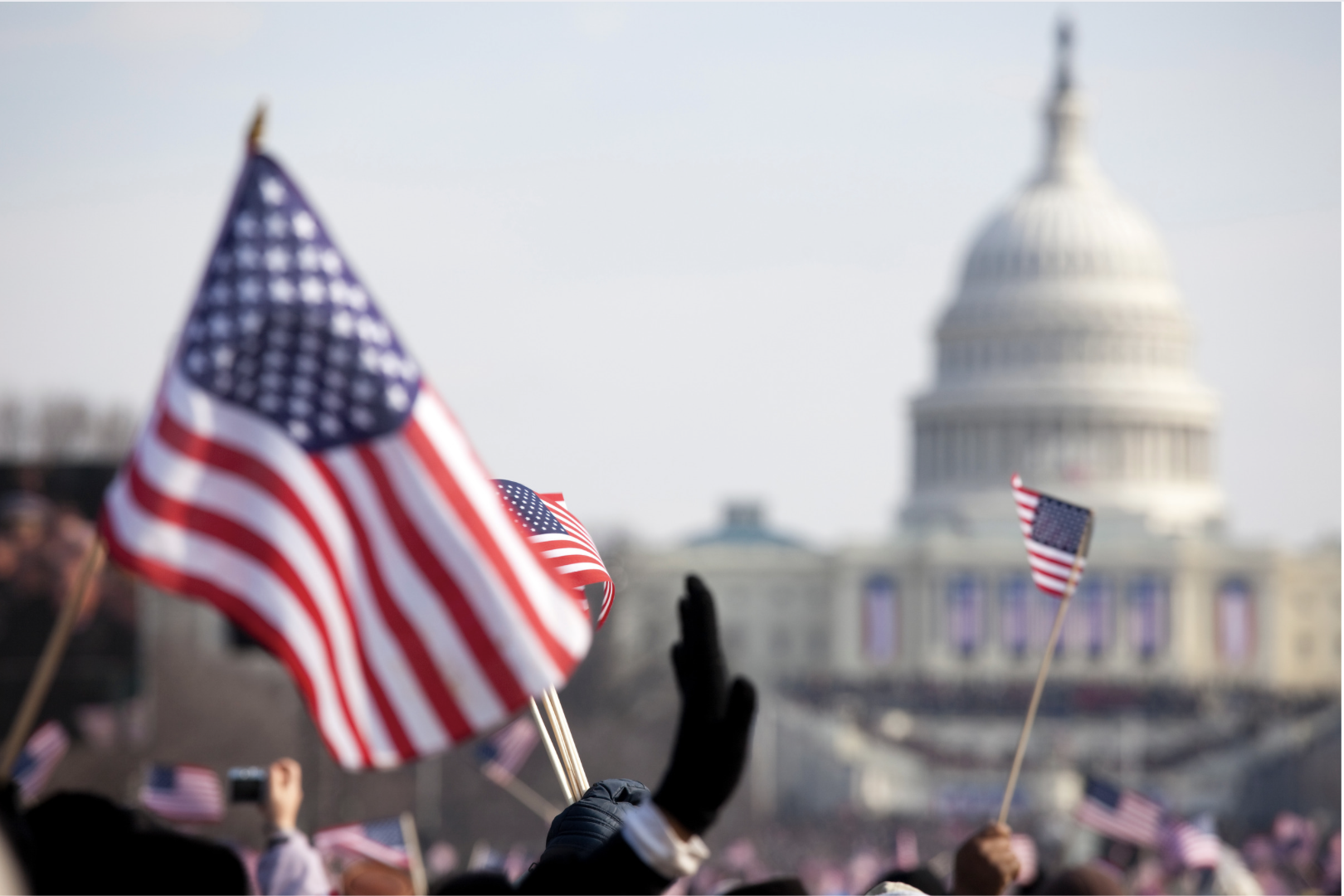
Every four years on Inauguration Day, the country watches as the president-elect recites the oath of office, parades through the nation’s capital, and attends numerous formal parties and balls to celebrate the beginning of a new presidential term. While less exciting than parades and balls, it is important to recognize the body of law that frames this Inauguration Day and that has allowed for the peaceful transition of presidential power in the United States beginning with President George Washington exiting office in 1797.
The majority of legal deadlines on Inauguration Day itself are mandated by the Twentieth Amendment of the United States Constitution. Commonly known as the “Lame Duck Amendment,” the Twentieth Amendment was ratified in 1933 and limits the amount of time a defeated president (or member of Congress) could remain in office between election and inauguration. The key provision of the Amendment reads:
“The terms of the President and the Vice President shall end at noon on the 20th day of January … of the years in which such terms would have ended if this article had not been ratified; and the terms of their successors shall then begin.”[1]
Per the Twentieth Amendment, Inauguration Day begins on the morning of January 20th with the president-elect’s arrival at the White House.[2] After arrival at the White House, the president-elect generally travels to the Capitol Building with the out-going president for the formal inauguration ceremony.[3] During this ceremony, the president-elect recites the oath of office in accordance with Article II § 1 of the United States Constitution,[4] and then gives an inaugural address.[5] The oath of office is traditionally recited at noon, when the Twentieth Amendment officially marks both the legal end of the out-going president’s term and the legal beginning of the president-elect’s presidency.[6] At the very moment the oath is taken, the president-elect becomes the commander in chief of the United States.[7] Following the inaugural address, the new president typically signs a series of key governing documents within the Capitol Building, participates in a parade flowing from the Capitol down Pennsylvania Avenue to the White House, and attends a series of events and balls that go into the early hours of the 21stt.[8] While the traditions of Inauguration Day have evolved over time (and can be set aside in times of crisis), the oath of office remains the official moment of transition from one president to the next.[9]
Despite the official legal beginning and end of presidential terms occurring at noon on the 20th, the legal transition of power from out-going president to president-elect begins months before Inauguration Day. Historically, presidential candidates begin to plan for governance whilst still campaigning during election year,[10] putting together transition teams, which exist as organizations legally separated from a candidate’s presidential campaign. Transition teams begin personnel vetting, policy planning, and organizing management agendas for the potential upcoming presidential term.[11] The incoming president has approximately eleven weeks between their election and inauguration day to organize their administration and make plans for policy.[12] This includes making over 4,000 political appointments, planning to oversee a budget of around $6 trillion dollars, and managing over 2 million federal employees and more than 2 million military and reserve forces.[13] Given the magnitude of these responsibilities, each candidate’s transition team begins to assess economic conditions, domestic priorities, foreign policy and potential national security threats, months before election, so that if the candidate is elected, they are prepared to govern when the oath of office is taken in January. The Presidential Transition Act of 1963 (“PTA”) was passed to support transition planning, authorizing the General Services Administration to provide financial support and services to the transition teams of the president-elect.[14] Given the increasing complexity of presidential transitions, subsequent amendments of the PTA expanded support for the presidential transition process by authorizing funding and support for pre-election activities for any eligible candidates.[15] Under the current PTA framework, the GSA and the outgoing administration provide resources, guidance, and reports to the president-elect and his or her transition team. For example, most presidents-elect receive daily or near-daily intelligence briefings prior to Inauguration Day.
In Season One, Episode Three of Aaron Sorkin’s “The Newsroom,” news anchor Will McAvoy remarks that “Every two years we drive to a fire station and overthrow the government, and there isn’t a policeman in the streets.”[16] Presidential transitions are a quadrennial reminder of a distinctly American tradition that emphasizes the rule of law and the will of the people over all else. Today, Monday, January 20th, this great American experiment turns yet another page in an unwritten future forever bending toward “a more perfect union.”
[1] U.S Const. amend. XX, § 1.
[2] Inauguration Day occurs every four years on January 20th, or January 21st if January 20th falls on a Sunday. https://www.usa.gov/inauguration.
[3] President’s Swearing in Ceremony, Joint Cong. Comm. on Inaugural Ceremonies, https://www.inaugural.senate.gov/presidents-swearing-in-ceremony; see also Inauguration at the U.S. Capitol, Architect of the Capitol (noting that 55 inaugurations (including Vice Presidential inaugurations) took place at the Capitol, seven took place outside Washington, D.C., six inaugurations took place in the White House, two took place in Washington, D.C., but not at the White House or the Capitol Building, and two at the Old Brick Capitol) https://www.aoc.gov/what-we-do/programs-ceremonies/inauguration#:~:text=The%2020th%20amendment%20to%20the,2021%20inauguration%20of%20Joseph%20R.
[4] See U.S. Const. art. II § 1 (“Before he enter on the Execution of his Office, he shall take the following Oath or Affirmation:– I do solemnly swear (or affirm) that I will faithfully execute the Office of President of the United States, and will to the best of my Ability, preserve, protect and defend the Constitution of the United States.”)
[5] Id.; see also, Ana Faguy, Here’s what to know about Donald Trump’s inauguration, BBC News (Jan. 15, 2025), https://www.bbc.com/news/articles/c2kxzpwqq25o.
[6] Ron Elving, The Rules for A Peaceful Transition of Power Between Presidents, NPR (Oct. 1, 2020), https://www.npr.org/2020/10/01/919006693/the-rules-for-a-peaceful-transition-of-power-between-presidents.
[7] If the country is ultimately unable to select a president by January 20th at noon, the first person in the line of succession, the Speaker of the House, would take the oath of office and assume the presidency. Id.
[8] See Ana Faguy, supra n. 5; see also, Carle Hulse, Obama Is Sworn In as the 44th President, NY Times (Jan. 20, 2009), https://www.nytimes.com/2009/01/21/us/politics/20web-inaug2.html.
[9] Nine Vice Presidents have taken the oath of office on days other than January 20th, eight upon the death of a President, and another following a Presidential resignation; President’s, supra note 3.
[10] Frequently Asked Questions about Presidential Transitions, Ctr. for Presidential Transitions, https://presidentialtransition.org/about-the-center/faqs-about-presidential-transitions.
[11] Id.
[12] Henry Hogue, Presidential Transition Act: Provisions and Funding, R46602, Cong. Res. Serv. (Updated May 22, 2024), https://crsreports.congress.gov/product/pdf/R/R46602.
[13] Id.
[14] Our role in presidential transitions, U.S Gen. Servs. Admin., https://www.gsa.gov/about-us/mission-and-background/our-role-in-presidential-transitions?topnav=about-us.
[15] Frequently, supra note 10.
[16] The Newsroom: The 112th Congress (HBO television broadcast July 8, 2012) https://play.max.com/show/ec852a72-c111-44af-bd81-0830484022d0.